Friday, October 8, 2010

Wind in the piñon

If you are a regular Back Porch blog reader, you recognize the long gap between this entry and the last. Well, it’s been a busy time, but it’s been busy because of my trip back to this lovely place pictured that you just might recognize.


I am immensely lucky to return to the Nada Hermitage in Crestone, Colorado for a two-week writing retreat, this time flying solo. The official reason for my trip is so I can work on my book. And I will. So far, however, I’ve written a journal entry, a couple of poems, a note back home to Cindy Lou, this blog entry; taken a bunch of pictures; and napped a couple of times.


I first thought I would title this entry ‘Quiet,‘ in honor of the Sangre de Cristo mountains just overhead. As I write this mid-afternoon Mountain time, however, sitting just inside my hermitage’s open window, the whistle of wind picking up through piñon pine reminds me it is this sound, for one, that makes this native Ohioan long for time in the mountains. It is so lovely! True, I can hear similar zephyrs on my back porch at home on a breezy fall afternoon, but witnessing the live music of wind and pine needle in the shadow of Kit Carson Peak reaches deeper into my core. It’s part of the retreat I so love to come up here for.


I drove the 1300 miles from Dayton to the Colorado front range in three days, making stopovers in Topeka and Pueblo. Yesterday about noon, when I headed up over the pass into the San Luis valley from Poncha Springs, I was struck by the yellow of the season-changing aspen leaves cast against the still deep green of neighboring conifers. Higher in the pass, aspen leaves were down. Winter is nearer there.


But no new snow in the mountains. Summer’s heat depleted the Sangre de Cristos of all of last winter’s remnants. I remember when I hiked here in July 2009, snow was still evident from the valley below. Not a whole lot, but some. By fall 2010, all snow had melted off.


Still, nights are getting colder here. Last week when I checked Crestone weather, lows were predicted in the mid-30s. Though highs were predicted in the sunny 70s, I expected to see frost sometime during my stay and looked forward to a morning fire in the hermitage stove.


One never knows how much rain one will experience in the desert foothills, here, just a dozen or so miles north of Great Sand Dunes National Park and Preserve. Last night, as I looked west across the valley toward the darkened San Juans maybe 80 miles off, lightning flashed over the distant peaks. Hours later after I went to bed, rain hit the hermitage roof hypnotically. As Thomas Merton observed, It is important to listen to the language of rain on the roof. It seemed more like music to me.


And then this morning, while taking my first look east up into the 14,000 feet peaks, the first of winter’s snow was evident in the higher elevations. Wow, I thought. So special!


I hope this to be a good omen for my writing.


***

For more information on the Nada Hermitage -- an absolutely beautiful place for a multi-week retreat for whatever reason you can conjure -- see http://www.spirituallifeinstitute.org/Nada.html.


You could come! ;-)


Today’s elder idea: If we skip discipline, an unfruitful looseness and lethargy result. If we leave ourselves wide open, we will never find our way to genuine freedom.


from ‘The Value of Discipline’

Spiritual Life Institute

Nada Hermitage

Tuesday, September 21, 2010

Legacy

As you might imagine, I’ve been watching Cincinnati Reds baseball religiously every game of late. As the regular season draws to a close with the local team in good shape to make it to the playoffs for the first time in fifteen years, I hate to miss anything. Those of us in southwest Ohio who root for Cinci sports teams know to enjoy success as it happens. You never how many years it might be until you make it back to the big money games. Carpe diem, don’t you know. Seize the day.


It’s been especially fun because Cindy Lou has caught the Reds’ bug anew and watches every game with me. She gets nervous as heck when Coco Cordero comes into the game late, but so do we all. I keep telling her, Yes, even though he’s blown 8 save opportunities, he’s also nailed down 37 or 38 games at this point. Ain’t bad. After all, all teams have good hitters who want nothing more than getting a big hit for a walk-off win in the ninth inning off of somebody’s closer. Coco’s cape may be tattered, but on most nights he still has what it takes to hold the victory.


Which brings me to today’s blog topic: legacy. The other day on the Reds’ television broadcast, the play-by-play guys told a story about the newest Red, Willie Bloomquist, who was picked up from Kansas City last week. The Reds were terribly shallow in the outfield with injuries so they picked up Bloomquist to help get them through the season. He won’t be going to the playoffs with them since he was added to the roster too late. Still, as a veteran on a team with lots of kids, he has an valuable job to do in the two weeks he’ll spend with the team.


The story goes that Bloomquist was standing in the dugout next to Chris Valaika, young reserve infielder and former Dayton Dragon. The Reds had baserunners at the time. Bloomquist pops this question to Valaika: ‘Tell me about your lead with bases loaded.’ Valaika thinks, then replies that he would take a normal lead, then after the pitch to the plate, move into his secondary (longer) lead, ready to take off if the ball is hit fair.


‘Wrong,’ says Willie, who then explains that with bases loaded, a runner could get doubled up if an infielder catches a hard line drive and snaps off a throw to an occupied base. ‘Stay close to the bag with bases loaded and one or two outs,’ he finishes. ‘Don’t take your team out of a possible rally.’ Reds announcer Chris Welsh, who talks playing technique a lot during games, said that base running tip one was a new one for him.


After hearing that story, I could imagine the conversation Bloomquist had with Reds’ manager Dusty Baker when he first got into the clubhouse: You’re the veteran. Talk to the kids. Keep their heads in the game. Teach them what you know. Lead by example. I’ll get you some playing time.


And, of course, that’s the beauty of this Reds’ team: a rich blend of young talent with savvy veterans, some who have been to the playoffs and all who know how to play the game. Bloomquist said he was happy to join the Reds, leaving a Royals team almost 30 games out of first. True, he won’t make it to the playoffs, but I thought about how good it must feel to at least be with a winner. And like so many of the team’s veterans in the final seasons of their careers, he gets to share what he has learned with the kids. And the kids are eager to listen. How much of a legacy is that?


Which makes me reflect on my own life experiences. I wonder from time to time if there is something I said about living or writing or thinking on which some former student out there still ruminates. I found out just last week that my new next door neighbor is a former student of mine. Sophomore English years ago at Wayne. First thing I said to him was that I hoped I hadn’t ruined him in the process. He laughed.


And what about the grandkids? I sure hope my love of birds and poetry and the Reds and life sticks with them as they grow through their teen years into adulthood. One can only hope.


One final thought on legacy from the man pictured above: Leo Cardenas, Reds’ shortstop when I was a kid. Five time All-Star. Gold Glove 1965. Batted .333 in the 1961 World Series against the Yankees. Led the NL in fielding twice. Voted into the Reds’ Hall of Fame in 1981. Lucky enough to meet him at the entrance to the Reds’ Hall of Fame last week when Cindy and I went down for a game.


Leo’s thoughts that day? More Reds’ Hall of Famers need to come down to the ballpark and Hall more often to encourage fans to come see games and support this great new team. Seems like we’re all in this together.


Today’s elder idea: When you play this game 20 years, go to bat 10,000 times, and get 3,000 hits, you know what that means? You’ve gone 0 for 7,000.


Peter Edward Rose


image: Photo of Leo ‘Chico’ Cardenas picked up at the Reds' Hall of Fame. You could go.

Monday, September 13, 2010

Muslim sisters

This is really an entry about sisters. Sorority. Women working together for the larger family good. A story told close to the anniversary of 9/11, an event in 2010 that seemed to focus more on burning a Quran in Florida and preventing a Muslim community center from being built two blocks from Ground Zero than the annual remembrance of that epic 2001 event that changed the landscape of New York City and apparently the hearts of many Americans.


I realize I’m a gender-outsider telling this story, but I am nonetheless an interested observer. My lovely Cindy Lou is one of those sisters involved in this story.


It all began in November 1995, I suppose, when the world turned its attention to the Hope Hotel at Wright Patterson AF Base for what would be known as the Dayton Peace Accords. A three+ year ethnic bloodbath was put to an end after leaders from all sides of the Bosnian conflict came to Dayton to talk and work out a peace agreement.


In the spring of 1996, my downtown church decided one of the things we could do to make the world a better place was to take on a refugee family from Bosnia and get them resettled in our fair city. Church World Services approved our request and we were told we would have three to four weeks to prepare to receive our guests.


One week later we got word that a Muslim refugee family was in flight and was expected to reach us within twenty-four hours. A housing arrangement was in the works, but not yet confirmed. Cindy Lou and I decided the best thing to do was welcome this family into our home for the short term until permanent arrangements could be made, a decision that changed our lives.


Not knowing what to expect -- except that our Muslim guests numbered five: mom and dad with three kids -- I shopped at the Halal Meats & Grocery store on Wayne Avenue so we could have some food when they arrived that would not offend. As it turned out, our guest family wasn’t rigid in their eating habits, and besides their being stunned at the variety of food at the local Kroger, all worked out well for the week+ they stayed with us. By that time housing had been arranged through another church family and lots of local trips to doctors, dentists, and government offices were shared with still other church folk. I still think sponsoring a refugee family was one of the best things our congregation has ever done.


Lots of water has gone under the bridge since our relationship with our once-refugee friends began that spring. In the summer of 1998 Cindy Lou accompanied the mom back to Bosnia to visit her own ailing mother. The kids have grown up, the older boy a Wayne High School graduate now serving in the US Navy. The younger twins are currently high schoolers with one recently invited to a call-back with the Dayton Philharmonic Youth Orchestra. All family members have become US citizens and, unfortunately, mom and dad have since divorced. Stress has its fallout, I suppose.


The kernel of this blog today, though, is what I saw in Cindy Lou’s face last Friday evening after she came back from the mom’s house following a tutoring session. Besides working a couple of minimal-paying jobs to keep food on the table and clothes on her kids’ backs, the mom has determined it necessary to take some classes at Sinclair Community College to get prepared for better paying work. And since she has to take language and writing classes, Cindy -- a retired English teacher par excellence -- was asked if she could help not only her, but a couple other English-as-a-second-language girlfriends from the old country also back in school.


The language and writing classes these women are taking aren’t easy. Cindy is amazed at how hard the assignments are. Still, on occasion when she returns from her tutoring Fridays, Cindy tells me about how these women didn’t get that much school work done, but instead sat around the dining room table drinking coffee and talking about how hard life is in America. One of the women wept on Friday saying how the office manager at her job is impatient and flat out mean to her.


Such insecurity talk stops Cindy Lou in her tracks. Here she is conversing with Muslim women who were uprooted from their lives in another land, transplanted into this wonderful but business-brutal US of A, and continually struggle with language, culture, family, and customs. Cindy stands in awe of these women and tells them so. She often tells them that she could not have done what they have already accomplished.


It is plain to me that Cindy and her cadre of new American girlfriends are becoming soul sisters. They share life as they experience it and in so doing build bridges among each other. They laugh, they cry, they swear in Bosnian on occasion, they drink coffee in sorority. As a guy, I’m left to hear Cindy’s stories and encourage her to continue this valuable work.


At a time when so many Americans are wary of our Muslim brethren, it is refreshing to see real women helping each other build stronger relationships, enriching community, enriching America. God, or Allah, bless those girls.


Today’s elder idea: I am opposed to the building of the "mosque" two blocks from Ground Zero.


I want it built on Ground Zero.

Why? Because I believe in an America that protects those who are the victims of hate and prejudice. I believe in an America that says you have the right to worship whatever God you have, wherever you want to worship. And I believe in an America that says to the world that we are a loving and generous people and if a bunch of murderers steal your religion from you and use it as their excuse to kill 3,000 souls, then I want to help you get your religion back. And I want to put it at the spot where it was stolen from you.


Michael Moore

for the rest of Michael’s blog entry, see:

http://www.michaelmoore.com/words/mike-friends-blog/if-mosque-isnt-built-no-longer-america


image: from michaelmoore.com

Wednesday, September 8, 2010

Liberation theology

I’m afraid I don’t have much patience with modern conservatism. I remember learning long ago in a history class that the essence of conservatism is to handle problems traditionally. Wikipedia confirms that by saying it promotes the maintenance of traditional institutions and supports minimal and gradual change in society.


Liberal folk, on the other hand, don’t mind trying something new -- a bit out of the box -- to fix a problem. To be fair and balanced, Wikipedia defines liberalism as the belief in the importance of liberty and equality. While different liberals might look at problems differently, the Wiki writer concludes that most liberals support such fundamental ideas as free and fair elections, human rights, free trade, and separation of church and state among other things.


I’ve considered myself a liberal, or progressive, my whole adult life. Based on what I just read, I’m still pretty okay with that.


So at this tenuous time in American life and economics, what are conservatives like Ohio’s own illustrious Speaker-of-the-House wanna’ be John Boehner up to? As far as I can tell, obstruction. I mean, after eight years of George W. Bush, Americans decided they wanted a change. They elected not only Barack Obama president, but gave enough seats to Democrats to control both houses of Congress. Sure seemed like a mandate for change to me.


The conservative response? Do not cooperate. Look like you are in negotiations with the Majority for improvements in health care, the environment, and Wall Street reform, but after you get concessions and when push comes to shove, don’t give a single vote for passage of any change. Stand tight. Wait out this tough time and then blame the ones who are trying to do something for screwing things up even worse. Complain loud and long how current problems are exclusive property of the Majority and hope voting Americans have short memories. We’ve learned time after time that, indeed, Americans do have short memories.


So why the rant against conservatives today? Well, it has to do mainly with one of their chief mouthpieces, Glenn Beck, who so many Americans listen to and watch on a daily basis. He stirs the political pot by making comments that my side of the aisle has a hard time stomaching. Like Obama is a racist. Like Obama hates all things white. Like Obama isn’t even American and thus all he attempts to do is not even Constitutional. Heavens. Oh, yeah: and everybody who agrees with Beck, Limbaugh, and Fox News are real American patriots and those currently working for change and improvement for small business and the middle class most certainly are the real problem.


Then the day or so after his Restoring Honor rally in the nation’s capital a few weeks ago, Beck came out on a Sunday news show to say he wanted to refine his accusation that Obama is a racist. I misunderstood Obama’s motivation, he said. Obama isn’t so much a racist as a leader motivated by liberation theology. That’s the President’s problem.


Odd, because when I attended Catholic high school back in the day, I learned that liberation theology was a proud guiding light for social justice. As I recall, it was centered in Latin American politics where a small group of rich landowners controlled the lives of the masses. Making life better for the poor and landless was the stuff of getting it right.


Now, however, in this topsy turvy world of the 21st century, finding fault with those who want to make life better for the disadvantaged is the political sport of the day. Refuse to help homeowners trying to stay afloat while supporting a financial bailout of banks that got so many of us into this mess in the first place. And by all means, when conservatives become the Majority this fall, tell Americans you will gut the new health care plan and repeal the last two years of liberal legislation. Heaven forbid, conservatives would hate to see anybody get something they didn’t earn. Unless, of course, it means going to bat for BP or extending tax cuts for the very richest Americans. It is now deemed socialistic, communistic, fascist, a product of Hitler, even demonic, to dedicate a chunk of our collective wealth to help the less fortunate and level the playing field for all.


Yipes. What’s happened to us? And yet we say we’re a Christian nation?


Today’s elder idea: Real Christian love is founded on commitment to a more just society and action to bring it about.

Gustavo Gutierrez

Peruvian theologian recognized as the Father of liberation theology

1973


Elder Idea #2: Liberation Theology Practiced Here.

Message board at Christ Episcopal Church, Dayton OH


image: ‘The Flower Carrier’ by Diego Rivera (1935)


Tuesday, August 31, 2010

1984 Apple's Macintosh Commercial

1984

Let’s see. I was a twelfth-year classroom teacher back in 1984 when on one afternoon in April, with freshman students in my junior high English class, I read out loud to them in my best dramatic voice, while they followed in their own, just-passed-out paperbacks:


It was a bright cold day in April, and the clocks were striking thirteen. Winston Smith, his chin nuzzled into his breast in an effort to escape the vile wind, slipped quickly through the glass doors of Victory Mansions, though not quickly enough to prevent a swirl of gritty dust from entering along with him.


The hallway smelt of boiled cabbage and old rag mats. At one end of it a colored poster, too large for indoor display, had been tacked to the wall. It depicted simply an enormous face, more than a meter wide: the face of a man of about forty-five, with a heavy black mustache and ruggedly handsome features.... It was one of those pictures which are so contrived that the eyes follow you about when you move. BIG BROTHER IS WATCHING YOU, the caption beneath it ran.


Though it was a little after 2 in the afternoon, I had, after months of planning, successfully melded a classic novel’s time signature into the real space and time of a group of American teenagers. Perhaps it was my coolest day as a teacher. I mean, here we were, experiencing the opening lines of George Orwell’s classic 1984 -- in 1984. It was so cool. The next couple of weeks reading and discussing the text were pretty cool, too.


I call your attention to this because of a couple of tangential connections I’ve come across lately.


First, a national hamburger franchise has come up with a series of commercials selling a sandwich that claims buying it is such a smart thing to do that you owe yourself doing something completely stupid. So a guy hauls his sandwich up on a ladder in a lightning storm with a golf club to recalibrate the satellite dish. Or another guy, sitting inside an old tire just above a rocky precipice, takes a bite and tells us how smart he is before a buddy rolls him into the chasm.


Maybe these ads bother me so much because they remind me of the way of politics these days: Say whatever you want loud and long enough, and it will become Truth. Say a provision in a health care proposal calls for death panels to kill off grandma. It isn’t true, but never you mind. Say it loud and often enough and polls and Congressional votes swing. Do something really dumb and we’ll all agree it’s really smart. Irritates me.


Second, following Glenn Beck’s Restoring Honor rally in Washington, I found a contemporary reference to 1984 in the news just this morning. Chauncey DeVega, a blogger over at AlterNet, sees Beck as twisting interpretations of history to make different points than were ever intended. He writes, “I’ve come to the conclusion that what he is doing is just nakedly Orwellian: destroy the truth in order to advance his idealogical agenda.” A group of pretty much all white folk holding a civil rights rally calling for a return to a more traditional America. WAR IS PEACE. FREEDOM IS SLAVERY. IGNORANCE IS STRENGTH.


I think we all can agree that 1984 was a horror story. Tragic romance. Erosion of privacy. No absolute truth. Selling out a lover at the threat of having your face eaten by rats. The gnawing question if we have become more like Winston and Julia than any of us feel comfortable to admit. Such was pretty good discussion-stuff for a high school literature class. As it is today.


Odd, I always felt the older civilization got, the smarter we’d become. We would learn from our ancestors’ errors and not only change, but make amends. The contradictions of doublespeak could certainly not flourish under today’s enlightened sunshine laws.


And yet, liberals are considered mentally ill by some conservatives while empathetic care for the sick is considered socialistic, fascist, even demonic. I mean, they want to kill grandpa! The whole thing depresses me.


Oh, one more thing. Apple Computer assured us that our year 1984 would not be like the story 1984. Why? Well, because the Macintosh computer would set us free. To be released the day after Super Bowl XVIII (the Raiders beat the Redskins, BTW) the Mac would let our computer work closer with our brains to create new and exciting stuff. Boy, have they ever. And now iTunes accounts keep track of every piece of music we buy on line from Apple. Geez. So much for avoiding Big Brother.


Still, I wish I could have used that first iconic Mac commercial in class. Now that would have been sweet.


Today’s elder idea: Ah, that great first Mac commercial. Classic stuff. How iconoclastic.


On January 24, Apple Computer will introduce Macintosh. And you'll see why 1984 won't be like 1984.


This blog is written, designed, and uploaded from a Mac. Surprise.

Tuesday, August 24, 2010

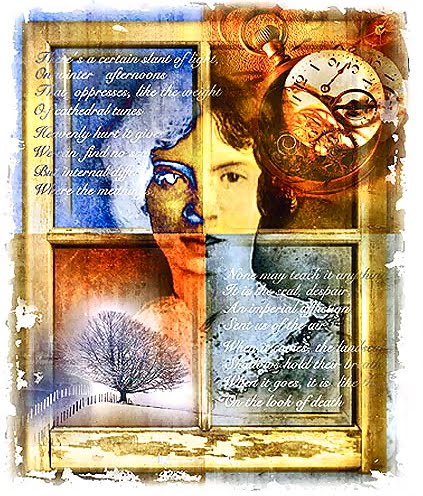
Emily wars

Emily Dickinson a lightning rod?


Some people sure seem to think so. Hard to believe in some ways, for a quiet 19th century woman who wanted nothing more than to take care of her invalid mother, cultivate beauty in the persons of flowers in her garden, and retreat to her room to write the stuff of her heart in sometimes odd but powerful verse.


Emily wrote intensely on topics important in her life. In everybody’s lives. And though she’s been dead for over 120 years, she is still so amazingly current. A couple new books again this year analyze some aspect of Dickinsonian lore that want to get us closer to the poet. The latest one, Lives Like Loaded Guns: Emily Dickinson and Her Family’s Feuds, was released just a month or so ago by a South African ED scholar. One review says the book ‘overturns the established assumptions about the poet’s life.‘ We all want to know more about her it seems.


So many want a little piece of the Emily legacy for their own. She’s big in women’s studies, American literature, world poetry, gardening, conflict management (sort of), nature study, and good old American history. In my own case, I’m a member of a writers’ group we call Emily’s Boys. (See www.emilysboys.com.) We had plenty of ideas for naming ourselves, but everything seemed to come back to Emily Dickinson. We talk about her often. I’ve referred to her in my own poetry as Mother.


She is an enigma that reaches out to us from a century past offering handwritten letters and poems that we know she never thought the public would see. But yet we have.


We’ve looked at her life through a magnifying glass that would, I am sure, have embarrassed the stockings off the girl. She was a very private person whose attention to detail in her various writings make her work a rich source of psychological and philosophical analysis. And she’s great to quote.


So it is with some puzzlement that I report a couple of guys I know who flat out hate the woman. Well, hate the poet, anyway.


The first guy is a Montana poet I met in Silver Gate, the little town at the northeast entrance to Yellowstone. He is a summer resident there, and wanted to hear nothing positive about Ms. Dickinson. For him, his poetry would meet its ultimate salvation if released in a mountain stream where his words could run free over the rocks. Emily was in another universe as far as he was concerned.


The other guy is a high school upperclassman friend of mine who I’ve admired through the years. He turned me on to Daniel Keyes’ Flowers for Algernon when we both were kids running forklifts at a local retail warehouse. He got into teaching too, and dedicated his career to inner city kids when he could have landed a different clientele in the suburbs. When he took off on Emily, he criticized her for pulling out of life and living in an ivory tower. Not the kind of source of energy he ever preferred.


For me, Emily continues as a kindred soul who I very much would have liked to have taken out for an ice cream. I would have liked to sit and hear her read her work and ask her a few questions about the craft. I would have loved to look at her ink-stained hands and into her deep, dark eyes to see what wonders made up the woman. I hear she was a red head. Heavens. And, yes, I’ve had a crush on her for years.


Emily Dickinson continues to be an inspiration and force in my life. She knew how to focus. She knew how to write. I owe her, as Mother, my own honest and authentic attempts to record true, good, and beautiful slices of life as seen from behind these, my very own, eyes.


Today’s elder idea: In the name of the Bee,

and of the Blossom,

and of the Breeze. Amen.


Emily Dickinson


Image credit: No idea. Downloaded 2002.